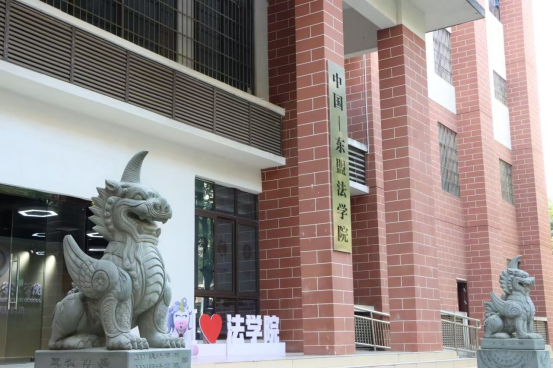
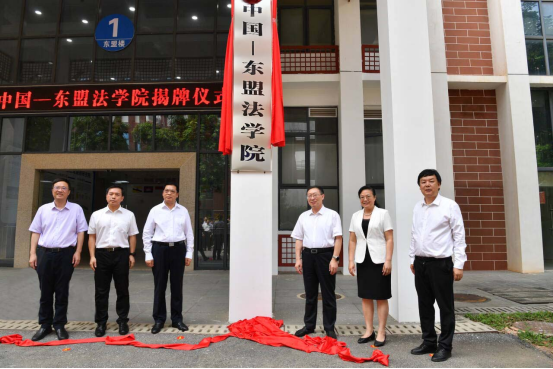
Introduction to China-ASEAN Law School/Guangxi Minzu University Law School
The China-ASEAN Law School was established in April 2024, jointly built by the Ministry of Education and the People's Government of Guangxi Zhuang Autonomous Region, with Guangxi Minzu University, the Autonomous Region's Department of Education, and the Autonomous Region's Department of Justice serving as the co-construction responsible units. Guangxi Minzu University acts as the main constructor, relying on its Law School for development.
The Law School of Guangxi Minzu University traces its origins to the Law Teaching and Research Section of the Political Science Department (one of the earliest three departments) established in June 1960. In 2003, the School of Politics and Law was established, followed by the Law School in 2010. Leveraging the university's comprehensive disciplinary advantages, the Law School has vigorously promoted discipline construction, talent cultivation, scientific research, and social services. After more than a decade of development, it has formed a complete legal talent cultivation system from undergraduate to doctoral levels and established three distinctive research directions: ethnic law, ASEAN law, and intellectual property (cyber data law), achieving fruitful results.
Disciplinary Characteristics
The school launched the law major in 1997, obtained master's degree authorization points in procedural law in 2003 and criminal law in 2006, and professional master's degree authorization in law in 2009. It introduced the undergraduate major in intellectual property in 2011, secured a second-level doctoral degree authorization point in Marxist Ethnic Theory and Policy along with a postdoctoral research station in 2014, obtained a first-level master's degree authorization point in law in 2017, had its law discipline approved as a Guangxi first-class discipline construction project in 2022, and acquired a master's degree authorization point in intellectual property in 2024. The school currently comprises six departments: Theoretical Law, Criminal Law, Civil and Commercial Law, Procedural Law, Intellectual Property Law, and International Law. It has 1,761 full-time undergraduate students, 523 full-time master's students, 9 full-time doctoral students, and 6 international students. The law major has been recognized as a high-quality major in Guangxi higher education institutions during the "11th Five-Year Plan" period (2007), a characteristic major in Guangxi undergraduate colleges (2018), a provincial-level first-class undergraduate major construction site (2019), and a national first-class undergraduate major construction site (2021). The intellectual property major has been honored as a distinctive and advantageous major in Guangxi higher education institutions (2014), a provincial-level first-class undergraduate major construction site (2021), and was selected as a provincial-level first-class undergraduate major construction site (2024). Additionally, the school boasts characteristic majors in law and intellectual property in Guangxi higher education institutions, with学科带头人 (disciplinary leaders) and key faculty members wielding significant academic influence domestically and within ASEAN countries.
Faculty
Through recruitment and cultivation, the school has assembled a well-structured faculty team in terms of age, educational background, professional titles, and expertise. It employs over 60 staff members, with 40% holding senior professional titles, 35% holding associate senior professional titles, and 25% holding intermediate professional titles. Among them, 45 hold doctoral degrees, 15 are qualified as doctoral supervisors, and 45 are qualified as master's supervisors. Several key faculty members have earned doctoral degrees in ASEAN countries, and over 60% of them have overseas study or exchange experiences. Professor Qi Aimin is one of the pioneers in cyber data law research in China, ranking fourth in intellectual property law on the list of the most influential scholars nationwide, and was selected as a "Bagui Scholar" in Guangxi. His monograph "The Original Theory of Information Law" was included in the national 12th Five-Year Plan textbooks, and his "Personal Information Protection Law (Draft)" was submitted to the 2017 National People's Congress. Professor Jiang Hui was selected as an "Outstanding Scholar" in Guangxi higher education institutions, and Professor Wang Wei enjoys special government allowances from the State Council. Furthermore, the school's faculty team has been honored as a "Bagui Scholar" team in Guangxi law, an innovation team in ASEAN civil and commercial law research in Guangxi, and a Huang Danian-style faculty team in autonomous region higher education institutions. The collaborative innovation team in intellectual property and the innovation team in ASEAN civil and commercial law research have been selected as "High-Level Innovation Teams in Guangxi Higher Education Institutions."
Talent Cultivation
Currently, the school offers two undergraduate majors: law and intellectual property. It has established an ASEAN Rule of Law Talent Class, conducting language teaching activities for ASEAN countries on weekends, and an ASEAN Excellent Rule of Law Talent Cultivation Class, strengthening the cultivation of compound abilities in "Southeast Asian non-common languages + law," and systematically constructing compound talent cultivation models with dual degrees such as "law + Vietnamese" and "law + Thai." It has also set up an Experimental Class for Outstanding Talents in Discipline Inspection and Supervision to further refine its distinctive talent cultivation layout. Additionally, the school has cultivated and trained over a thousand high-level legal talents for ASEAN and provided training and guidance to over 5,000 international students from ASEAN countries.
The school emphasizes the cultivation of postgraduate students' academic and research abilities, implementing a dual-tutor system for postgraduates and hiring over a hundred off-campus practical supervisors to guide internships, social surveys, and other activities. In the past five years, doctoral and master's students have participated in academic exchanges over 300 times, with each cohort having master's graduates pursuing doctoral degrees at renowned universities domestically and abroad. The school currently boasts over 20 provincial-level and above teaching and research platforms and more than 200 practical teaching bases in public security, prosecution, law, and other fields. It has established teaching venues such as the China-ASEAN International Legal Negotiation Laboratory, the Multivariate Dispute Resolution Laboratory, the Moot Court, the Mock Arbitration Tribunal, and the Legal Professional Skills Competition Center.
Scientific Research
The school houses key research and education bases such as the China-ASEAN Legal Training Base of the China Law Society, the Southern Ethnic Law Research Base of the State Ethnic Affairs Commission, the Collaborative Innovation Center for Ethnic Law and Regional Governance Research, the China-ASEAN Political and Legal Culture Research Center, the Guangxi Intellectual Property Training (Guangxi Minzu University) Base, and the Guangxi Trademark Brand Talent Training Base. The Guangxi Intellectual Property Development Research Institute has been selected as a Chinese Think Tank (CTTI).
Currently, the discipline's scientific research platforms, teams, and project funding exceed 20 million yuan. In the past five years, it has undertaken 12 national-level scientific research projects (including one major project funded by the National Social Science Fund), 30 provincial and ministerial-level scientific research projects, and received 32 provincial and ministerial-level and above scientific research awards. It has published over 50 monographs and more than 400 academic papers in public journals. The discipline has long been committed to international, domestic, and local legislation, government decision-making, and social services, undertaking a substantial amount of drafting and evaluation of local legislation in Guangxi, legislative consultation and demonstration, and providing policy advisory reports.
International Exchange
The school places great emphasis on international exchange and cooperation. It annually hosts thematic academic seminars with ASEAN countries, having organized high-end forums such as the China-ASEAN Legal Luminaries Forum and the China-ASEAN Rule of Law Talent Cultivation Forum, as well as the China-ASEAN Procuratorial Exchange and Cooperation Seminar. It has invited experts and scholars from the 11 ASEAN countries to participate and exchange ideas, establishing sound cooperative exchange relationships with multiple universities, including Hanoi Law University in Vietnam, Rangsit University in Thailand, Tanjungpura University in Indonesia, Thammasat University in Thailand, and the National University of Laos. The school encourages and supports faculty and students to visit ASEAN countries for exchanges and regularly organizes special activities such as "Exploring ASEAN," "ASEAN Study Tours," and "Student Exchange Programs with ASEAN Universities."
During the "15th Five-Year Plan" period, guided by Xi Jinping Thought on Socialism with Chinese Characteristics for a New Era, the school will fully implement the spirit of the 20th National Congress of the Communist Party of China and all subsequent plenary sessions, thoroughly apply General Secretary Xi Jinping's important requirements for Guangxi's work, adhere to the principles of cultivating talents with both moral integrity and professional competence, and dedicate itself to nurturing high-quality legal talents "based in Guangxi and facing ASEAN," striving unitedly to build a distinctive, high-level, modern comprehensive university.