School of Media and Communication: An Overview
Established on March 11, 2014, the School of Media and Communication at Guangxi Minzu University is a joint initiative of the Publicity Department of the CPC Guangxi Committee, Guangxi Radio and Television Station, the Publicity Department of the CPC Liuzhou Municipal Committee, and Guangxi Minzu University. It currently offers 4 undergraduate programs: Broadcasting and Hosting Art, Radio and Television Directing, Communication Studies, and Journalism. The School also offers two professional master’s programs, namely Journalism and Communication; and Drama, Film and Television.
The School has received numerous honors, including:
• 1 Provincial-level Featured Program: Broadcasting and Hosting Art;
• 2 Provincial-level First-class Undergraduate Programs: Broadcasting and Hosting Art, Radio and Television Directing;
• 1 National-level First-class Undergraduate Course: Audio-visual Language;
•4 Provincial-level First-class Undergraduate Courses: Audio-visual Language, News Reporting and Writing, Impromptu Oral Communication, and Fundamentals of Broadcasting Performance;
• 2 Provincial-level Courses in Curriculum-Based Values Education: Advertising Planning and Production, and Introduction to Communication Studies.
The School has 68 faculty members, including 54 full-time teachers and 24 senior academics. Its faculty team features experts with national and provincial recognition. National honors include 1 National-Level “Dual-Qualified” Teacher who also serves as Party Branch Secretary, 1 National Leader in Agricultural Periodicals, and 1 National Leader in Radio, Television and Online Media Industries. Provincial honors include 1 Provincial Model Teacher, 1 Provincial Distinguished Young Talent, 1 Guangxi Cultural Master and “Four Batches” Talent Award for Culture, 2 Provincial Young Master Teachers in Universities, and 13 Best Teachers in Moral and Value Education in Guangxi. Industry honors include 1 member of the Top 100 Talents in Guangxi’s Radio and TV Industry, 1 member of the Top 100 Talents in Guangxi’s Press, Publication, Radio, Film and Television Industry, and 1 member of the Top 100 Experts in Guangxi’s United Front Work.
The School also engages a large cohort of distinguished scholars and senior professionals from industry as mentors or visiting professors. Together they form a “dual-qualified” teaching team (combining academic expertise and professional practice) with strong professional ethics, rigorous pedagogy and innovative spirit.
The School gives top priority to disciplinary development, maintaining a clear focus in its fields of study. This approach is supported by comprehensive, state-of-the-art teaching facilities. It operates four provincial-level talent-training and practice bases, including the Base for China-Foreign People-to-People Exchange and Omni-Media Industry-Education Integration, the Joint Training Center for Journalism and Communication Postgraduates, the Guangxi Radio and Television Audio-visual Creation Base, and the Off-Campus Practical Education Center for Editing, Publishing and Cultural Communication.
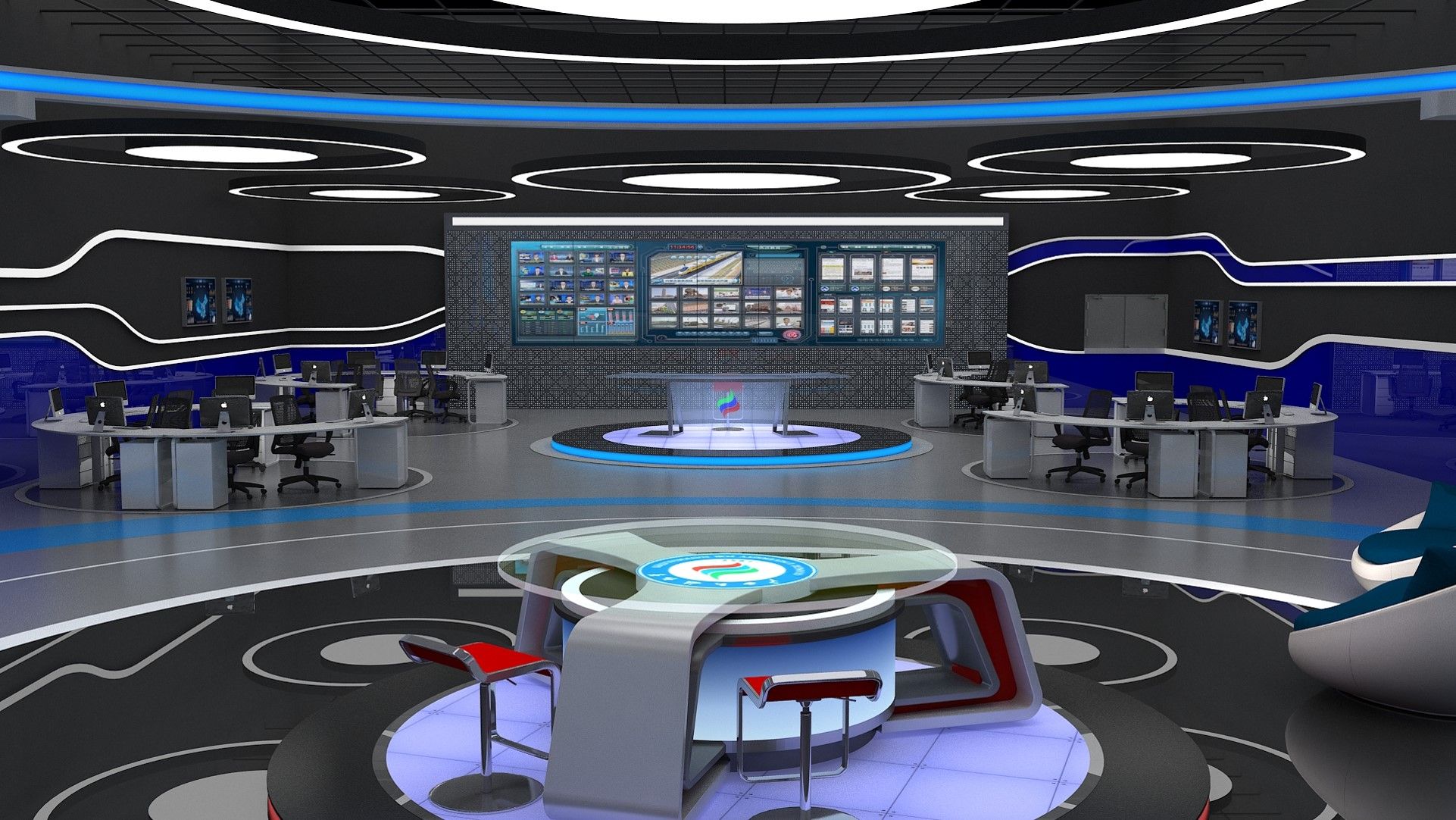
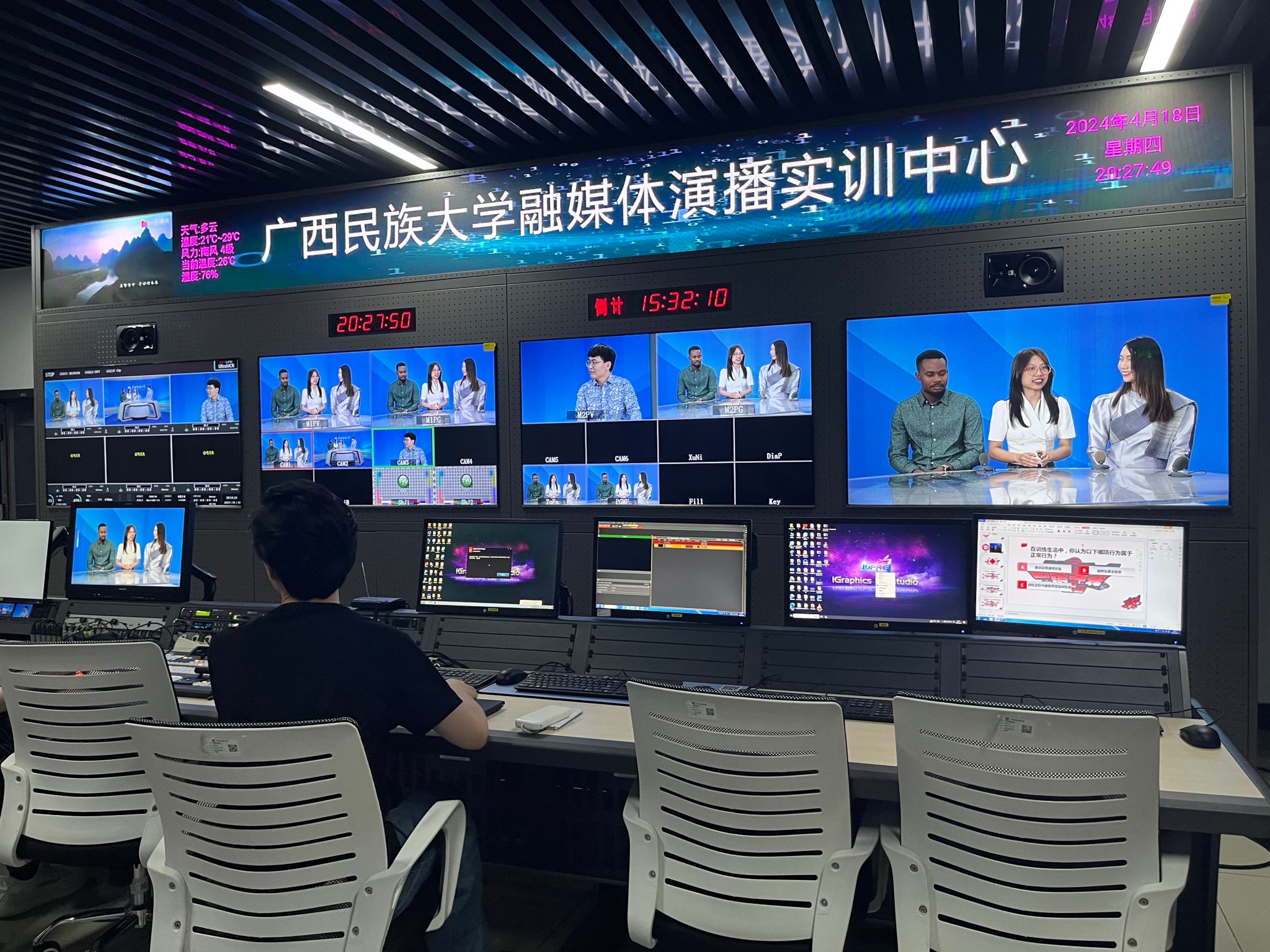
The School houses three major experimental centers, notably the Media Convergence Broadcasting Training Center, the China–ASEAN (Guangxi) Audio-visual Art Creation Center, and the Media Experimental Teaching Center. In addition, the School has multiple specialized laboratories, such as Broadcasting Studios, Virtual Studios, Television Broadcasting Labs, Non-linear Editing Labs, Digital Media Labs, Editing and Publishing Labs, and Digital Publishing and Communication Labs as well as more than 40 practical teaching facilities such as recording studios and live-streaming studios. With over 2,500 square meters of laboratory space and more than 2,200 sets of teaching equipment, the School operates its own media platforms, including a newspaper, a website, an official WeChat account, and a Douyin (TikTok) account, which serve as practical teaching platforms for students.
Guided by the philosophy of “Virtue, Knowledge, Technological Integration, and Artistic Excellence,” the School is committed to nurturing high-caliber, versatile media professionals who meet the needs of National Rejuvenation. Anchored by Journalism and Communication, the School focuses on quality-oriented development. It leverages Broadcasting & Hosting and TV Directing as its two “wings” to distinguish itself in the Omni-media era. Through this strategic approach, the School has achieved significant milestones across four key areas: talent cultivation, academic research, social service, and cultural inheritance.
Since its establishment, the School has fostered an ethos of “Unity, Innovation, and Pragmatic Application”. It upholds a teaching standard of “Pursuing Excellence to Empower Others” and a learning spirit of “Diligent Action and Authentic Voice”. Building on this culture, the School runs signature programs such as the “New Media Voices” Culture Month and the “Words & Transmission” Academic Salon. To date, it has educated over 3,000 high-caliber professionals.
Students are also highly active in academic competitions, amassing over 1,000 honors—including over 200 national and over 500 provincial awards. Graduates are employed across national and provincial mainstream media outlets—including Xinhua News Agency and China Media Group—major media corporations, and a wide range of other industries, receiving strong societal acclaim. Growing number of students pursue advanced degrees: nearly 100 have been enrolled in master's or doctoral projects at top institutions like Peking University, Renmin University of China and Communication University of China, as well as international universities.
The School also encourages faculty to engage in academic research and participate in teaching competitions at all levels. Over the past five years, faculty members have secured more than 100 teaching and research projects, including five from the National Philosophy and Social Science Fund, 51 at the provincial/ministerial level, 30 university-level projects, and 25 industry-sponsored projects. Academically, the faculty has published 14 monographs and textbooks and nearly 300 academic papers, with over 90 appearing in core journals. Their work has garnered more than 70 awards for teaching and research excellence.
The School has successfully organized major academic and cultural events such as the National Annual Conference of Online Editors, the Annual Meeting of the International Communication Committee (China Film and Television Society), and the Symposium on New Perspectives and Practices in Cross-Cultural Communication of Chinese Images. Other notable activities include the 2025 “Looking China” Youth Film Project (Guangxi Tour), the Lancang–Mekong Cooperation 7th Anniversary Celebration, and the Guangxi Classic Recitation Competition.
Upholding the principles of pragmatism and innovation, the School actively reforms its teaching methodologies and continuously optimizes its talent cultivation model. It strives to become a first-class teaching and research institution in Guangxi with national prominence. The School is dedicated to establishing itself as a premier hub for applied media professionals, a research base for media development, a center for the industrial innovation, and a continuing education platform for media practitioners.