Introduction to the School of Physical Education and Health Science
1. Overview and Foundational Development
The School of Physical Education and Health Science originated from the Physical Education Teaching and Research Office of Guangxi Minzu University. It began enrolling junior college students in 1992, admitted its first undergraduate cohort in Physical Education in 1999, established the Department of Physical Education in 2000, and was renamed the School of Physical Education and Health Sciences in 2003. In 2006, it launched the undergraduate program in Social Sports Guidance and Management and obtained master's degree authorization in two secondary disciplines: Traditional Ethnic Sports and Physical Education Training. In 2017, the School obtained authorization for the first-level discipline master's program in Physical Education and the Professional Master's Degree in Physical Education. In 2024, it added the undergraduate program in Sports Training, establishing a comprehensive undergraduate-to-master's talent cultivation system. The School comprises two departments—Physical Education and Sports Training—along with two divisions: the Public Physical Education Division and the Training Division. It also houses three centers and five laboratories, forming a complete teaching and service system.
Guided by its motto "Educating Through Sports, Pursuing Excellence" and upholding the university's ethos of "Integrity and Scholarship, Harmony in Diversity," the college remains committed to "cultivating talent for the Party and nurturing professionals for the nation." It strives to develop high-caliber, multidisciplinary sports professionals. Currently, it enrolls 1,803 full-time students, including 1,660 undergraduates and 143 graduate students. The faculty comprises 79 full-time staff members, including 57 full-time teachers. Among them, 31.58% hold senior professional titles, 29 serve as master's degree supervisors, and 10 are internationally or nationally certified referees. The college is a council member of the Ethnic Sports Committee of the Chinese Ethnic Studies Association and the permanent institution of the Guangxi School Sports, Health, and Arts Association. It has been honored as a "National Model Collective for Ethnic Sports" and a "National Advanced Collective for Mass Sports," establishing itself as a key hub for regional sports talent development.
2. Discipline Development and Talent Cultivation
The college has established a disciplinary framework centered on "one core with two wings, integrating undergraduate and graduate programs." It focuses on undergraduate majors in Physical Education and Sports Training, supported by the collaborative development of a first-level master's degree program in Sports Science (comprising four sub-disciplines) and a professional master's degree program in Sports. The Physical Education major is designated as an autonomous region-level first-class major construction point, while Ethnic Traditional Sports is recognized as an autonomous region-level characteristic discipline construction point. Courses such as "Ethnic Traditional Sports" and "Sports Dance" have been awarded the autonomous region's "First-Class Course" designation. Basketball and soccer are designated as Ministry of Education high-level athletic teams, while dragon boat racing and volleyball are university-level high-level athletic teams, showcasing distinct disciplinary strengths.
Talent cultivation has yielded remarkable results. Over the past three decades, the college has educated nearly 10,000 graduates, with employment placement rates exceeding 90% for five consecutive years. In the last five years, it has supplied over 100 outstanding recruits to the military, ranking first among all university departments for five consecutive years. The college adheres to the principle of "promoting learning through competition and enhancing teaching through competition." In recent years, students have won over 1,000 awards in various competitions, achieving outstanding results in domestic and international events such as the National Student (Youth) Games and World Championships. In 2025, our students achieved numerous honors across competitions at all levels: 2 gold and 1 silver at the world level, 9 gold and 5 silver at the continental level, 76 gold, 29 silver, and 19 bronze at the national level, and 47 gold, 49 silver, and 21 bronze at the regional level.
3. Scientific Research Innovation and Social Service
The college actively promotes the integration of science and education, refining research management systems and incentive mechanisms. In recent years, it has secured one national-level research project and over 60 provincial/ministerial-level projects, published more than 60 papers in core journals, released 18 monographs, obtained 9 patents, and won multiple teaching achievement awards from the autonomous region and the State Ethnic Affairs Commission. Faculty members demonstrate outstanding teaching capabilities, achieving a "zero breakthrough" for Guangxi universities by winning the first prize in the 2024 Third National College Physical Education Teachers' Teaching and Training Skills Showcase.
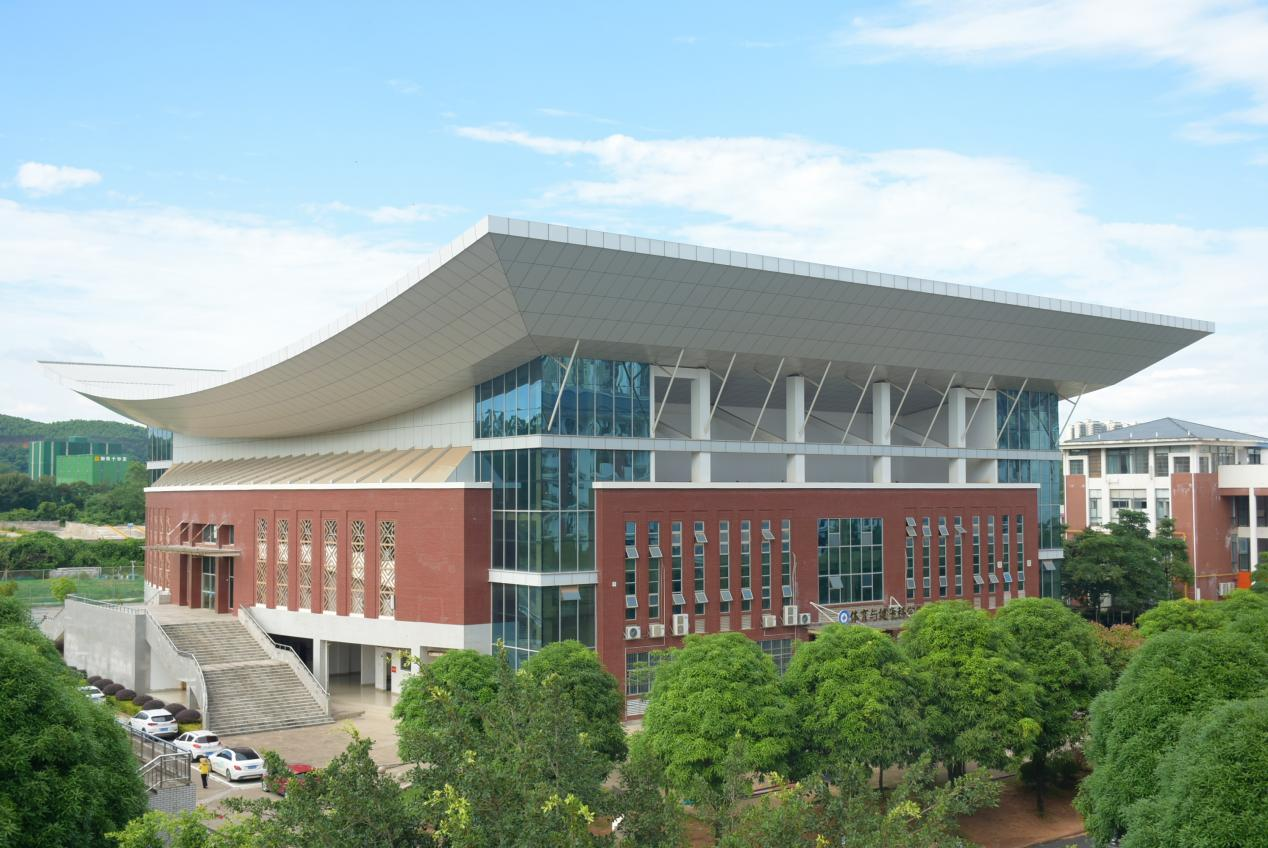
Social service impact is significant, with annual sports training programs serving over 3,000 participants and hosting more than 10 major sporting events. The college oversees critical initiatives including Guangxi's sports college entrance examinations and physical education teacher vocational skills competitions. It successfully hosted major events such as the 13th Autonomous Region Student Games and the shuttlecock competition at the 1st National Student (Youth) Games, while the release of the Nanning Declaration generated widespread societal resonance. The college actively participates in community sports development and public fitness volunteer services, drafting multiple policy documents in the sports sector to provide robust support for local sports advancement and rural revitalization. Educational facilities continue to improve, with three campuses boasting over 150,000 square meters of sports venues, providing solid support for teaching, training, and research.
4. International Exchange and Development Vision
In line with the university's international orientation, it leverages platforms such as the Guangxi Ethnic Sports Research and Development Center, the ASEAN-China Centre, the Autonomous Region's Traditional Ethnic Sports Base, and the Guangxi Minzu University Institute of Sports Culture. It hosts the China-ASEAN Ethnic Sports and Culture Exchange International Academic Symposium, and its dragon boat team is frequently invited to participate in international competitions while organizing and hosting various international friendly matches. The university is progressively refining its international education development plan and actively advancing cooperative education programs with ASEAN countries. During the China-ASEAN Expo, the university organizes cooperative exchanges within the sports industry. It actively dispatches high-level referees to officiate at international invitational competitions held both within and outside the region.
Moving forward, the college will remain rooted in ethnic regions, focusing on building a distinctive, high-level sports institution. It will deepen educational reforms, strengthen interdisciplinary integration, enhance talent cultivation quality and scientific innovation capabilities, and continue contributing sports expertise to the national strategies of building a sports powerhouse and a healthy China, as well as to the development of a magnificent Guangxi.